
For over a decade, Bitcoin followed a predictable rhythm:
halving → supply shock → retail mania → blow‑off top → deep bear market.
But that rhythm is gone.
The arrival of institutional capital, especially through spot Bitcoin ETFs, fundamentally rewired the market’s plumbing. Bitcoin no longer behaves like a retail‑driven speculative asset. It now trades like a macro‑sensitive, institutionally‑held financial instrument.
This article breaks down exactly why Bitcoin’s historical cycles collapsed and why that’s not a failure, but a graduation.
1. The Old Crypto Market: A Reflexive Retail Engine
Before institutions entered, Bitcoin’s price action was shaped by three powerful forces.
1.1 Retail Reflexivity
Retail traders tend to buy because price is rising, not because fundamentals changed.
This created a self‑reinforcing loop:
- Price goes up
- Retail FOMOs in
- Price accelerates
- More retail piles in
This reflexivity produced the explosive bull markets of 2013, 2017, and 2021.
1.2 Leverage‑Driven Volatility
Retail traders used:
- 20x–100x leverage
- Offshore exchanges
- High‑risk perpetual futures
Liquidations amplified every move.
Volatility wasn’t a bug—it was the engine.
1.3 Narrative Velocity
Crypto narratives spread at the speed of social media:
- “Ethereum killers”
- “DeFi summer”
- “NFT mania”
- “Metaverse boom”
Narratives created capital flows, not the other way around.

“Retail reflexivity and narrative-driven crypto markets.”
2. Spot ETFs Changed the Market’s Plumbing
The launch of U.S. Bitcoin spot ETFs was not just another product.
It was a structural transformation.
ETFs introduced:
- Regulated custodians
- Daily creation/redemption flows
- Institutional execution desks
- Portfolio‑level risk management
- Compliance‑driven capital allocation
This shifted Bitcoin from a retail casino to a Wall Street‑integrated asset class.
3. Institutional Capital Plays by Different Rules
Institutions don’t behave like retail traders. Their incentives reshape the entire market.
3.1 Longer Time Horizons
Pension funds, sovereign wealth funds, and asset managers think in:
- quarters
- years
- decades
They accumulate slowly and rebalance methodically.
3.2 Lower Tolerance for Volatility
Institutions must justify risk to boards and clients.
They use:
- hedging
- risk‑parity models
- volatility targeting
- position sizing frameworks
This naturally compresses volatility.
3.3 Systematic Rebalancing
Many funds maintain fixed allocations (e.g., 1–3% BTC).
This creates predictable flows:
- Bitcoin pumps → they sell to rebalance
- Bitcoin dumps → they buy to rebalance
This stabilizes price action.
3.4 Correlation Constraints
Bitcoin is now part of multi‑asset portfolios.
If correlations rise during macro stress, institutions reduce exposure.
Bitcoin is no longer isolated—it’s tied to global liquidity.

“Institutional portfolio rebalancing and Bitcoin allocation.”
4. Why Bitcoin’s Historical Patterns Broke
The old models no longer work. Here’s why.
4.1 The Failure of Post‑Halving Rallies
Historically, halvings triggered massive bull markets.
But now:
- Institutions price in halvings years ahead
- ETFs smooth out supply shocks
- Rebalancing flows counteract reflexive buying
The halving is no longer a surprise catalyst—it’s a scheduled event.
4.2 The Collapse of Q4 Seasonality
Q4 used to be Bitcoin’s strongest quarter due to:
- holiday speculation
- retail bonuses
- hype cycles
Now:
- institutional flows dominate
- macro conditions matter more
- Q4 is just another quarter
4.3 Volatility Compresses Instead of Explodes
This is the biggest structural shift.
Volatility used to expand into bull markets.
Now it compresses because:
- ETF flows are steady
- Leverage is lower
- institutions hedge
- liquidity is deeper
Bitcoin is becoming more like digital gold and less like a meme stock.
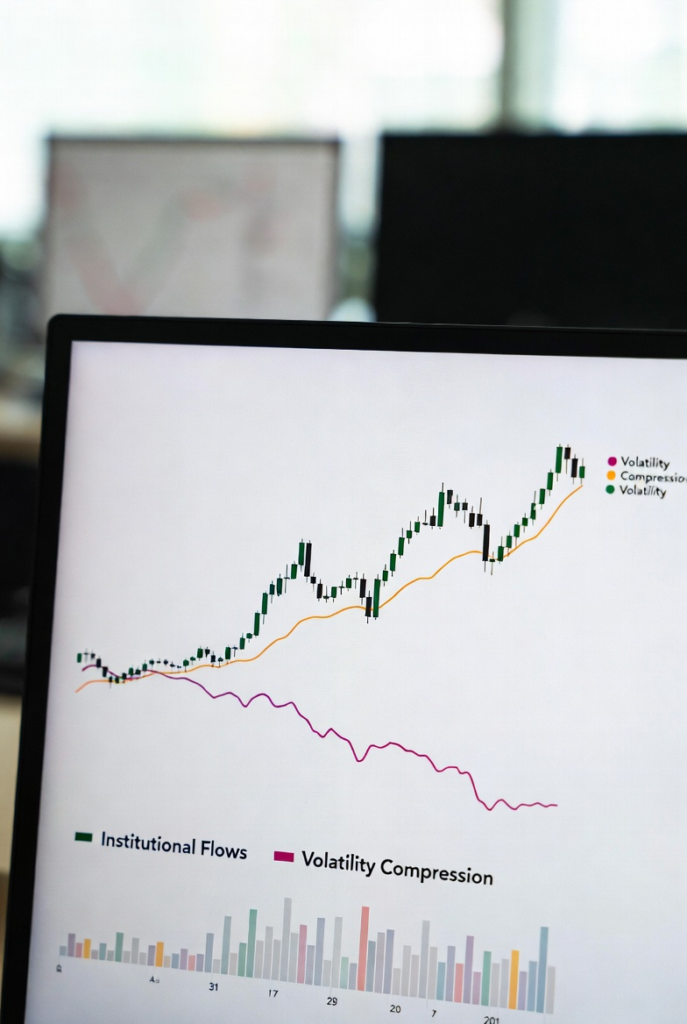
“Bitcoin volatility compression in the institutional era.”
5. Crypto Didn’t Fail — It Graduated
Many traders think Bitcoin “lost its magic.”
But the truth is far more bullish:
Bitcoin is no longer a fringe asset.
It’s becoming infrastructure.
This graduation means:
- more stability
- more liquidity
- more institutional adoption
- more integration into global finance
The trade‑off:
- fewer 100x blow‑off tops
- more sustainable long‑term growth
Bitcoin didn’t break.
It matured.
6. What This Means for Traders and Investors
6.1 For Beginners
- Expect fewer wild swings
- Focus on long‑term accumulation
- Understand macro trends—they matter more now
6.2 For Crypto Veterans
- Old models (4‑year cycles, Q4 rallies) are obsolete
- Institutional flows are the new driver
- Volatility compression often precedes structural repricing
6.3 For Builders and Founders
- Institutional adoption increases credibility
- Compliance and custody matter more
- Real utility will drive the next wave
7. The New Crypto Market Playbook
Here’s the emerging structure of the post‑ETF era:
- Macro liquidity drives direction
- ETF flows set the baseline trend
- Institutions dampen volatility
- Retail still drives altcoin cycles
- Bitcoin becomes a global reserve asset
The game didn’t end.
The rules changed.
Conclusion: The Future Is Institutional
Bitcoin’s historical cycles didn’t disappear—they evolved.
The market is now deeper, more stable, and more globally integrated.
Crypto didn’t fail.
It graduated.

Leave a Reply to Anonymous Cancel reply